
Mastering Dig Safe in Maine: A Strategic Framework for Asset and Property Protection
Protect your project margins, property, and crew by mastering Maine’s "Call Before You Dig" protocols. From commercial infrastructure projects to residential backyard improvements, discover how to avoid costly utility strikes and ensure fully compliant digging.
5/18/20263 min read
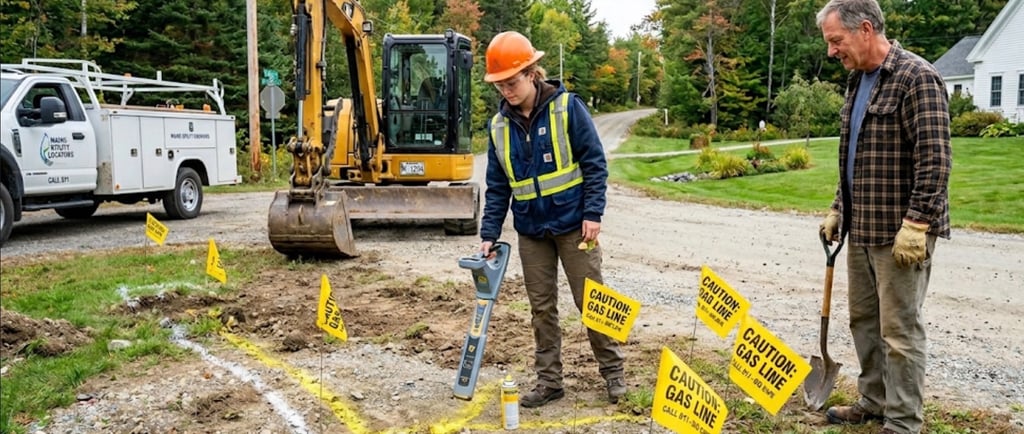
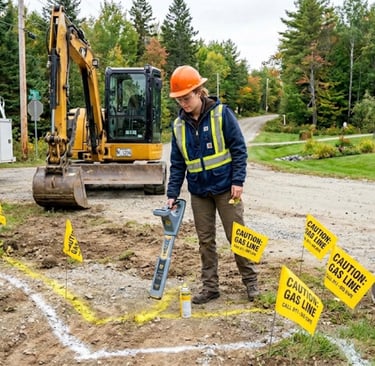
In both heavy civil contracting and residential property management, breaking ground is a milestone of progress—but without rigorous verification, it is a high-risk event. In Maine, treating the "Call Before You Dig" law as a mere administrative box to check, or assuming it "only applies to big construction crews," is a multi-thousand-dollar gamble.
This framework provides an operational overview for construction professionals, project managers, and homeowners alike on how to navigate Maine-specific damage-prevention regulations to ensure strict asset protection, compliant excavation, and uncompromising safety.
Mitigating Financial Risk: The 30:1 True Cost of a Strike
When an excavator or homeowner strikes an underground utility, the immediate repair invoice from the infrastructure owner is only the tip of the iceberg. The Common Ground Alliance (CGA) consistently documents that the indirect-to-direct cost ratio of a utility strike averages 30:1.
Whether it occurs on a commercial jobsite or in a residential backyard, a "simple" $2,000 fiber or gas line puncture rapidly balloons into a catastrophic expense due to cascading liabilities:
Emergency Response Overhead: Local fire, police, and emergency management services bill heavily for site evacuations, neighborhood road closures, and active hazard mitigation.
Property Damage and Service Disruption: Hitting a power line can fry expensive household appliances or delicate industrial equipment. For a homeowner, a severed internet cable means a sudden, unexpected bill and days without connectivity.
Regulatory Sanctions and Liability: The Maine Public Utilities Commission (MPUC) aggressively enforces Chapter 895 (Damage Prevention Regulations). Fines can reach up to $5,000 per violation for failing to notify or digging before a ticket is cleared. If you dig without a ticket, you are almost always held 100% liable for all damages.
Maine-Specific Compliance: Navigating Local Statutes
Failing to understand the unique nuances of Maine’s Dig Safe laws is where many out-of-state contractors, hurried crews, and well-meaning homeowners stumble. Compliance requires precision execution across four distinct pillars:
The 72-Hour Legal Window: You must notify Dig Safe at least three business days (excluding weekends and legal holidays) prior to commencing any excavation work.
Mandatory White Pre-Marking: In Maine, the person doing the digging is legally required to pre-mark the proposed boundaries of the dig area using white paint, flags, or stakes before the utility locators arrive on site. For a homeowner putting in a garden bed or a fence line, outlining that specific area in white paint tells locators exactly where to focus.
The Non-Member Operator Gap: Dig Safe is a centralized notification center, but not all utility operators are members. In Maine, water districts, sewer departments, and private industrial complexes frequently maintain independent infrastructure networks. Excavators and homeowners must cross-reference municipal maps or use tools like oktodig.com to manually notify non-member operators (like your town's local water district).
The 18-Inch Mechanical Tolerance Zone: Once utilities are designated by their respective color codes, the use of mechanized equipment (excavators, skid steers, trenchers, or rototillers) is strictly prohibited within a safety envelope extending 18 inches horizontally from the outer edge of the marked facility. Within this zone, lines must be carefully exposed using hand tools or non-destructive vacuum excavation.
Residential vs. Commercial: Safety is Everyone's Resource
Achieving zero-incident site execution requires moving beyond baseline compliance into proactive risk management, regardless of the project's scale.
For Homeowners: Do not rely on guesswork or assumptions like "my utility lines must be buried deep." Many fiber optic lines or secondary power cables sit just a few inches beneath the sod. If you are hiring a professional landscaper or fence contractor, verify that they have pulled a valid Dig Safe ticket before allowing them to unload equipment on your lawn.
Ticket Expiration vs. Mobilization Rules: While a Maine Dig Safe ticket remains legally valid for 60 days, you must commence work within 30 days of the ticket's issuance. If project delays push your initial groundbreaking past day 30, the ticket becomes void, and a new 72-hour notice is required.
Dynamic Mark Preservation: Weather, heavy track traffic, and lawn mowing easily obliterate paint and flags on active jobsites or residential properties. If any markings become obscured before the work is done, operations must halt immediately and a re-mark must be requested.
The Bottom Line: In Maine, the legal and financial burden of protecting underground infrastructure rests squarely on the person turning the dirt. Utilizing Dig Safe is a completely free service that acts as a mission-critical safety shield. Whether you are safeguarding corporate project margins or protecting your family's home and property, treat damage prevention as a mandatory discipline: call 811, respect the tolerance zone, and execute with precision.
Related Articles:
The Maine Standard: Maximizing Property Value Through Strategic Site Execution
The Compliance Factor: Why Professional Guidance is Non-Negotiable
Services
EPA and Maine Department of Environmental Protection certified expert site development including land clearing, forestry mulching, erosion and sediment control, excavation, tree removal, and access road construction for your commercial, industrial, residential, and agricultural projects.
services.info@crosscountrylandservices.com
(207) 320-3390


UEI: W7ZHSQWKC8N6
CAGE: 1AEB9