
Protecting the Pine Tree State: Why Slope Stability and Stabilization Are Critical in Maine’s Changing Climate
Discover why slope stability is critical for Maine infrastructure and ecosystems during heavy rains. Learn how Presumpscot Formation clay impacts site safety and explore advanced geotechnical solutions like TRMs, bioengineered terracing, and subsurface drainage.
6/30/20263 min read
Did you know that Maine’s iconic, rolling landscapes face a hidden risk every time a heavy storm rolls through?
With the recent influx of severe weather and intense rain events across New England, managing the terrain isn't just a regulatory checkbox—it is a critical necessity for infrastructure resilience, project longevity, and environmental preservation. For civil projects, commercial developments, and municipal infrastructure, understanding the mechanics of slope stability has never been more vital.
The Core Challenges of Maine’s Terrain
Managing earthwork in Maine requires a deep understanding of our unique geography and climate patterns. When heavy rains hit, several factors converge to create high-risk site conditions:
The Vulnerability of the Presumpscot Formation
Many of Maine's coastal, riverine, and low-lying areas sit on what is geologically known as the Presumpscot Formation. This glacial-era soil is composed of fine silt and clay layers that are highly sensitive to moisture changes. When dry, it can appear perfectly stable. However, when saturated by multi-day rain events, pore water pressure rapidly increases, drastically reducing the soil's shear strength. What was solid ground can quickly transform into a volatile slide zone.
High-Stakes Infrastructure Risks
Saturated slopes lead to localized washouts, mudslides, and catastrophic embankment failures. For civil corridors, utility right-of-ways, and commercial sites, a single slope failure carries heavy consequences:
Structural Compromise: Undermining roads, bridge abutments, and nearby building foundations.
Logistical Disruption: Forcing emergency road closures and halting critical supply chains.
Financial Strain: Escalating project costs through expensive, reactive emergency remediation rather than proactive control.
Environmental Stewardship and Water Quality
As stewards of Maine's natural resources, protecting our local ecosystems is just as critical as protecting the built environment. When an unstable hillside collapses, tons of sediment flush directly into our pristine rivers, lakes, and coastal bays. This massive influx of suspended solids:
Chokes out aquatic habitats and degrades essential fish spawning grounds.
Skyrockets turbidity levels, disrupting municipal water sources and local wildlife.
Transports loose surface contaminants into the broader watershed.
Implementing robust stabilization acts as a vital frontline defense to ensure our natural water quality remains uncompromised.
Proactive Solutions for Compliant, Resilient Site Execution
Modern site development relies on engineering methods designed to secure vulnerable terrain before the clouds open up. Moving past temporary fixes, three primary stabilization strategies provide long-term protection against heavy rainfall:
Geotechnical Turf Reinforcement Matting (TRMs)
Rather than relying on temporary erosion control blankets made of straw or coconut coir that decompose in a single season, high-performance TRMs provide a permanent engineering solution.
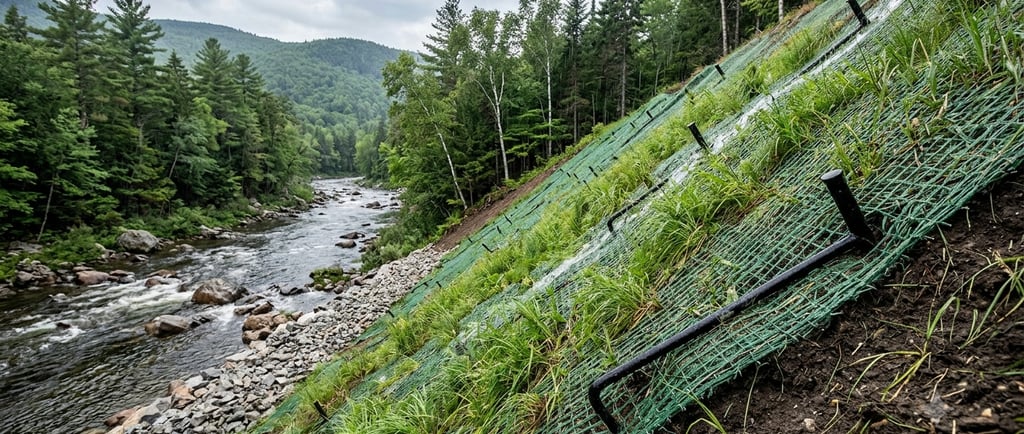
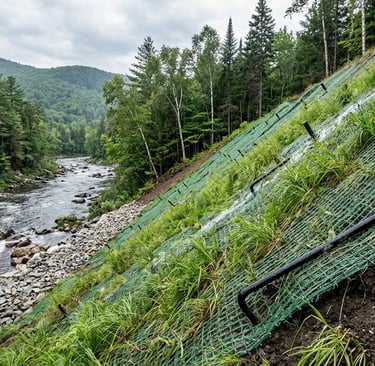
The Mechanism: Synthetic TRMs are woven from dense, UV-stabilized polymeric fibers anchored flat against a bare, graded slope. Once laid, the area is seeded. As vegetation takes hold, its root systems weave directly into the synthetic matrix.
The Benefit: This creates an incredibly strong "living armor." The matting mechanically locks down the topsoil, absorbing the impact of heavy raindrops and preventing sheet erosion. It allows a natural, green vegetative slope to withstand high-velocity stormwater runoff that would traditionally require heavy, costly stone rip-rap.
Terracing & Bioengineered Retaining Structures
When a slope's incline is too steep, gravity continuously works against it, pulling earth downward. Terracing changes the physical geometry of the land to minimize this force.
The Mechanism: A long, steep incline is re-engineered into a series of shorter, flat steps or terraces. This design physically interrupts the path of stormwater, preventing runoff from gaining high-speed velocity as it moves downhill.
The Bioengineered Advantage: Instead of relying solely on massive, rigid concrete walls—which can trap water behind them and eventually crack—bioengineering integrates structural frameworks with living plant material. This includes techniques like live fascines (bundles of live branches buried in trenches along the slope) or timber crib walls packed with structural backfill and live cuttings.
The Benefit: As these buried branches establish roots, they bind the disparate subsurface soil layers together deep underground. The weight of the slope is distributed evenly across the flat terraces, and the growing root systems naturally pump excess moisture out of the hillside.
Advanced Subsurface Drainage Systems
Surface water is easy to spot, but subsurface water is often the true culprit behind massive slope failures. When heavy rain saturates a hillside, hydrostatic pressure builds up within the soil voids, pushing the individual soil particles apart until the entire mass begins to behave like a fluid.
The Mechanism: To tackle this hidden threat, advanced subsurface systems are installed. This involves placing a strategic network of perforated pipes wrapped in geotextile filter fabric, installing deep French drains, or drilling horizontal drains straight into the side of vulnerable slopes.
The Benefit: These systems provide groundwater with a path of least resistance. Instead of building up immense pressure behind the slope face, the water infiltrates the perforated system and is safely, systematically channeled to a designated discharge point at the toe of the hill. Keeping the internal core of the hill drained ensures the soil retains its structural shear strength, even during consecutive days of severe rain.
Building a Resilient Future
As weather patterns continue to evolve, incorporating proactive stabilization strategies into the early planning and lifecycle of civil and commercial infrastructure projects is paramount. By understanding local soil dynamics and leveraging advanced geotechnical solutions, we can successfully mitigate risks, protect project footprints, and preserve the natural beauty of Maine for generations to come.
Services
EPA and Maine Department of Environmental Protection certified expert site development including land clearing, forestry mulching, erosion and sediment control, excavation, tree removal, and access road construction for your commercial, industrial, residential, and agricultural projects.
services.info@crosscountrylandservices.com
(207) 320-3390


UEI: W7ZHSQWKC8N6
CAGE: 1AEB9