The Breath of the Coast: Why Maine’s Tidal Crossings Matter
Why Maine’s Tidal Crossings Matter
5/2/20265 min read
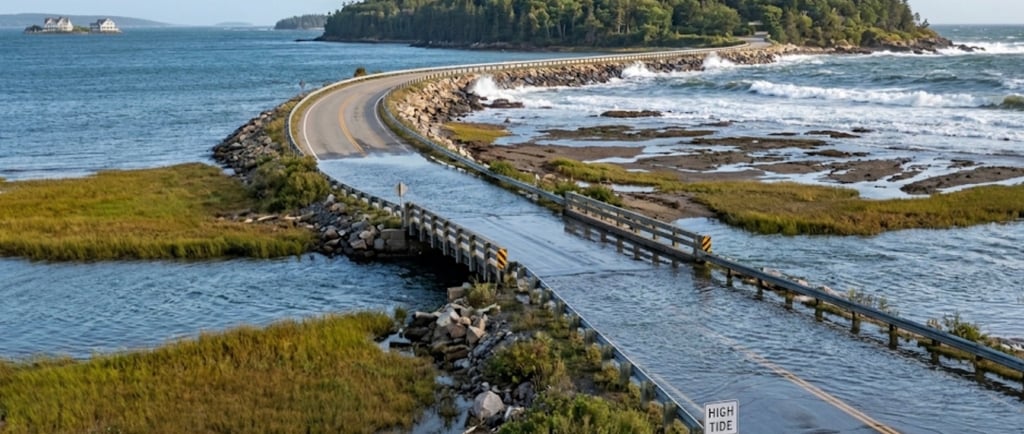
Maine’s coastline is a jagged masterpiece of granite, salt spray, and secret inlets. But where the land meets the sea, there is a delicate rhythm—a literal “breath” of the ocean that flows in and out of our coastal wetlands. At the heart of this rhythm are tidal crossings: the bridges and culverts that allow the Gulf of Maine to reach our inland marshes.
While they might look like simple infrastructure, these crossings are the gatekeepers of some of Maine’s most vital and threatened ecosystems. To understand their importance, we have to look beyond the asphalt and into the complex hydrological mechanics that sustain life on the edge of the sea.
The Dynamic Difference: Stream vs. Tidal
To understand the technical nuances of coastal engineering, we must distinguish between standard stream crossings and the complex bidirectional physics of a tidal crossing.
A stream crossing is largely a “one-way street.” The goal is to move freshwater downstream, focusing on velocity and capacity to prevent the pipe from scouring the bed during spring melt. A tidal crossing, however, is a “two-way thoroughfare.”
The Reversing Flow: Twice a day, the water's direction reverses by 180 degrees. An undersized culvert creates a “tidal lag,” where the marsh fails to fill or drain at its natural rate.
The Salt Wedge: These crossings must manage the “salt wedge”—where heavy, dense salt water pushes under lighter freshwater. Restrictive crossings trap freshwater on the surface, altering the soil chemistry that native vegetation depends on.
The Pulse of the Salt Marsh and the “Great Grass War”
A healthy salt marsh depends on the unrestricted “tidal pulse.” When a crossing acts like a tourniquet, it triggers a chain reaction of botanical and geological decline.
Tidal Subsidence: When a culvert is “perched” (set too high), water becomes impounded upstream. In a healthy marsh, root mats of Spartina patens (Saltmeadow cordgrass) create a firm floor. Constant saturation causes these roots to rot; the marsh floor literally sinks, or subsides, making it more vulnerable to storm surges.
Invasive Takeover: The salinity gradient is the marsh’s primary defense. If a crossing restricts saltwater, the area becomes brackish. Phragmites australis (Common Reed) moves in, creating 12-foot-tall monocultures that act as a biological desert, choking out native nesting habitats.
Blue Carbon: These salt flats are massive carbon sinks, sequestering carbon at rates 10 times higher than those of mature forests. Restrictive crossings cause these marshes to release the stored carbon back into the atmosphere as methane or CO_2.
The Sanctuary in the Grass: The Saltmarsh Sparrow
The ecological stakes are perhaps highest for the Saltmarsh Sparrow, an endangered specialist that is the “canary in the coal mine” for coastal health. These birds build nests just inches above the ground in high-marsh grasses. Their entire reproductive cycle is a race against the moon; they must hatch and fledge their young between the highest spring tides. When poorly functioning crossings trap water upstream, they eliminate this narrow window, resulting in complete nest failure. If the sparrows are failing, it is a definitive sign that the marsh is drowning.
The Biological Highway: Fish Migration
For Maine’s diadromous fish—like Alewives, Blueback Herring, and American Eels—a tidal crossing is the “front door” to their spawning grounds.
The Velocity Barrier: If a culvert is too narrow, the tide is forced through at high speeds. Fish cannot swim against this "jet" and burn their energy reserves waiting for a slack tide, becoming easy prey for predators.
The Perched Barrier: A perched culvert might be accessible for only an hour at the absolute peak of high tide, preventing thousands of fish from reaching freshwater ponds.
The Siltation Threat: Species such as Rainbow Smelt require clean gravel. Tidal restrictions cause sediment to "silt in," smothering spawning habitats before the fish even arrive.
Strategic Stewardship: Engineering with Nature
A good tidal culvert design is about mimicking nature rather than fighting it. The best modern crossings in Maine are essentially “invisible” to the tide and the creatures that depend on it.
Stream Simulation and Nature-Based Design
Instead of forcing the stream into a round pipe, designers replicate natural channel conditions. This is a specialized field where technical expertise meets environmental stewardship:
Substrate Continuity: The engineers we work with design using open-bottom culverts or arches so the natural streambed (cobble, gravel, sediment) continues straight through the crossing without interruption.
Proper Span: To maintain natural hydraulics, the engineers we work with design structures to span the full bankfull width—typically 1.2 to 1.5 times the natural channel width—matching the culvert’s slope and elevation to the natural streambed gradient.
Sizing for the Tidal Prism
Engineers calculate the tidal prism—the volume of water that naturally moves in and out of the marsh—and size the crossing to allow unrestricted flow with minimal head differential. This maintains natural salinity and sediment transport.
Velocity, Depth, and Resilience
By meeting specific velocity and depth criteria, we ensure fish can swim through without exhaustion, even during key migration periods. Furthermore, these larger, open structures are more stable during major storms and rising sea levels, significantly reducing the risk of scour, culvert failure, or road washouts.
The Reality of Coastal Execution: Navigating the Mud and the Mandates
While the ecological benefits are clear, the path from a restrictive pipe to an open-bottom arch is a complex logistical mountain. For Town Managers and Stewardship Coordinators, success isn't just about the "why", it’s about the "how."
Navigating the Regulatory Gauntlet: Coastal projects must meet the rigorous standards of the Maine DEP’s Natural Resources Protection Act (NRPA) and the U.S. Army Corps of Engineers (USACE). The "1.2x bankfull width" rule is often a legal requirement for Aquatic Organism Passage (AOP) certification.
Managing the Tidal Clock and Biosecurity: Unlike inland work, tidal zones require a 24/7 mindset. Crews must time excavations to the minute to avoid incoming tides. Furthermore, a "Clean-In, Clean-Out" protocol is mandatory to ensure heavy equipment doesn't introduce invasive Phragmites seeds into the marsh.
Low-Impact Machinery: Protecting "Blue Carbon" and nesting habitat requires specialized, high-flotation machinery that operates on unstable soils without causing deep compaction or rutting.
The ROI of Resilience: Nature-based, open-bottom designs are a strategic investment. They reduce long-term maintenance costs because the structure doesn't fight the tide. Furthermore, these designs often unlock significant federal and state grant funding from agencies like NOAA and the Maine Coastal Program.
Diagnostic Resources for Town Managers & Partners
Identifying high-priority restrictions is the first step toward securing restoration grants. You can explore known tidal restrictions, marsh migration paths, and sea-level rise scenarios using these essential Maine datasets:
Maine Tidal Restriction Atlas: A specialized diagnostic tool for identifying coastal infrastructure that currently limits natural tidal flow.
The Nature Conservancy - Maine Coastal Resilience Viewer: Use this interactive map to identify critical conservation lands and evaluate how coastal habitats will respond to future environmental shifts.
Maine Geological Survey: Sea Level Rise/Storm Surge Viewer: A vital tool for town planning, allowing users to visualize the impacts of various sea-level rise and storm surge scenarios on existing infrastructure.
A Strategic Infrastructure Partnership
At the end of the day, restoring Maine’s tidal crossings is about more than just "fixing a road." It is about a specialized approach to civil engineering that respects the rhythm of the Gulf of Maine. By combining technical site execution with environmental stewardship, we ensure that Maine’s infrastructure supports both our communities and the wild ecosystems that make our coast unique.
Related Articles:
Navigating the digital landscape for Maine's climate-ready infrastructure
The compliance factor: Why professional guidance is nonnegotiable
Services
EPA and Maine Department of Environmental Protection certified expert site development including land clearing, forestry mulching, erosion and sediment control, excavation, tree removal, and access road construction for your commercial, industrial, residential, and agricultural projects.
services.info@crosscountrylandservices.com
(207) 320-3390
UEI: W7ZHSQWKC8N6
CAGE: 1AEB9