The Hidden Perimeter: Why Biosecurity is the New Frontier of Site Development
BIOSECURITY
4/10/2026
In the modern landscape of site execution, security has traditionally focused on physical barriers such as fencing, lighting, and surveillance. However, as global supply chains tighten and environmental regulations evolve, the most significant threats to a site’s integrity are often microscopic or botanical in nature.
Biosecurity—the set of measures aimed at preventing the introduction and spread of harmful organisms—is no longer just for laboratories or farms. It is a critical pillar of compliant, sustainable land development.
The Vectors of Infiltration
A construction site is a high-traffic gateway. Every piece of equipment, every boot, and every load of fill dirt can act as a potential carrier of biological contaminants. In site development, biosecurity risks generally fall into three categories:
Invasive Species: Seeds or root fragments (like Japanese Knotweed) that compromise foundations and asphalt.
Pathogens: Soil-borne diseases that devastate local flora or contaminate groundwater.
Contaminated Aggregates: “Clean” fill that is teeming with dormant biological threats.
Strategic Site Hygiene: The Three-Pillar Framework
To protect site integrity from the ground up, we integrate these protocols directly into the developmental lifecycle:
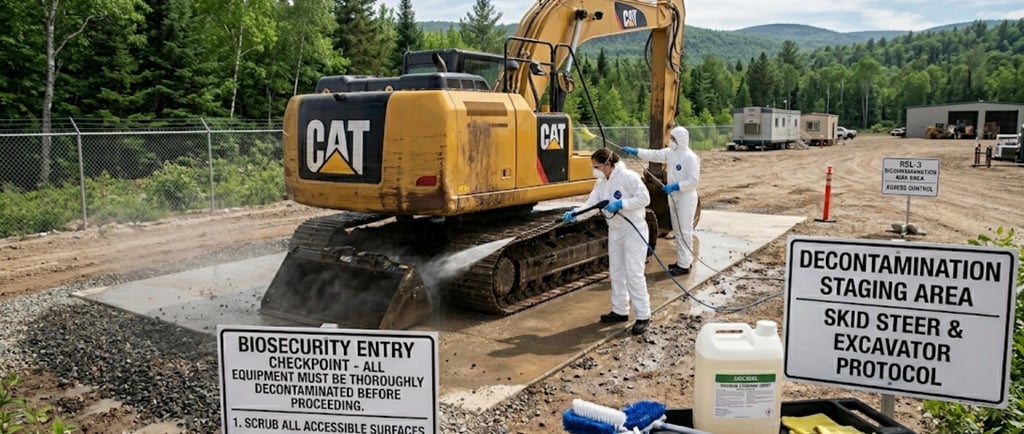
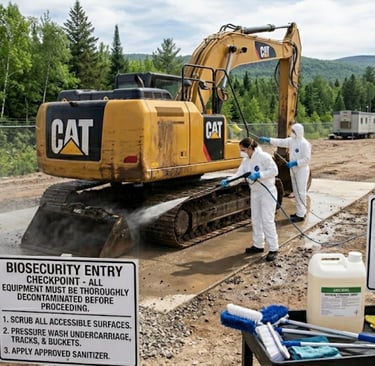
Equipment Decontamination: We mandate rigorous protocols requiring all heavy machinery to pass through designated “Wash Zones” to neutralize biological hitchhikers before they can be tracked across the property.
Batch-Certified Sourcing: We audit quarries and borrow pits for current “Weed-Free” certifications, ensuring all imported materials are laboratory-verified as pathogen-neutral at the source.
Zonal Management: We segment the site into strictly defined “clean” and “work” zones, creating physical barriers to minimize the potential for biological exposure.
Critical Applications: Where Biosecurity is Mandatory
In sectors where high-stakes execution is the baseline, this level of rigor is a hard requirement:
Military & Defense: Projects at Bangor Air National Guard Base or Portsmouth Naval Shipyard must comply with strict DoD environmental standards. Site work requires a “Clean In / Clean Out” policy to protect secure government assets.
MaineDOT Infrastructure: Any stream crossing is a high-risk vector. To comply with MaineDOT Best Management Practices, contractors must demonstrate decontamination before moving between watersheds to prevent threats such as Rock Snot (Didymo).
Utility & Energy Corridors: Transmission lines through the North Maine Woods act as “superhighways” for invasive species. We implement inspection “Checkpoints” to prevent seeds from spreading across vast distances.
Drinking Water Protection: In watersheds such as Sebago Lake and Mooselookmeguntic Lake, soil-borne pathogens can affect public health. These sites require Batch-Certified Sourcing for every yard of fill.
Conservation Access: For the Maine Coast Heritage or Somerset Woods Trusts, the mission is minimal impact. We provide the written Biosecurity Plans, now mandatory in their RFP processes.
2026 Regulatory Outlook: The New Standard of Care
As of Spring 2026, the regulatory landscape in Maine has shifted. We have evolved our protocols to stay ahead of these emerging requirements:
LD 1661 Compliance: With the passage of the Invasive Species Management Act (LD 1661), Maine has established a unified interagency oversight office. Our audit trails are designed for Interagency Transparency, satisfying DEP, Forestry, and Fisheries inspectors simultaneously.
Climate-Resilient Stormwater Rules: Under the updated Chapter 500 Stormwater Management rules, biosecurity now includes flood-risk mitigation. We implement proactive perimeter stabilization to ensure “wash-on” events from extreme weather don’t compromise a biosecure site.
Defending the Insurance Gap: As 2026 insurance markets introduce “Biological Contaminant Exclusions,” our batch-certification archiving provides the documented “due diligence” necessary to protect a client’s liability standing.
Technical Readiness: Bridging the Field and the Cloud
A strategic partner must be as competent in administration as they are in execution:
100% DEP-Certified Workforce: Every member of our 10 full-time crews is Maine DEP-certified in erosion and sediment control and OSHA 10 certified.
Mobile Operations Capable: We provide self-sustained crews for remote or off-grid site execution, bringing decontamination units directly to the point of impact.
Administrative Fluency: We are Electronic Invoicing (iRAPT/WAWF) Capable, ensuring seamless integration with federal payment systems.
The “Strategic Infrastructure” Difference
This is where the line is drawn between a “vendor” and a Strategic Partner. A Strategic Partner recognizes that environmental stewardship is inseparable from operational success. By treating biological threats with the same technical rigor as structural engineering, we ensure that a project remains a stable, compliant, and valuable asset for decades.
Related Articles:
Protecting Maine Land Trust Vitality: The Strategic Role of Forestry Mulching and Fire Safety Measures
Services
EPA and Maine Department of Environmental Protection certified expert site development including land clearing, forestry mulching, erosion and sediment control, excavation, tree removal, and access road construction for your commercial, industrial, residential, and agricultural projects.
services.info@crosscountrylandservices.com
(207) 320-3390


UEI: W7ZHSQWKC8N6
CAGE: 1AEB9